
Blog
How mission requirements shape space RF amplifier efficiency
How frequency coverage, waveform linearity, and operating conditions shape electrical demand, thermal load, and mass in spacecraft RF systems.
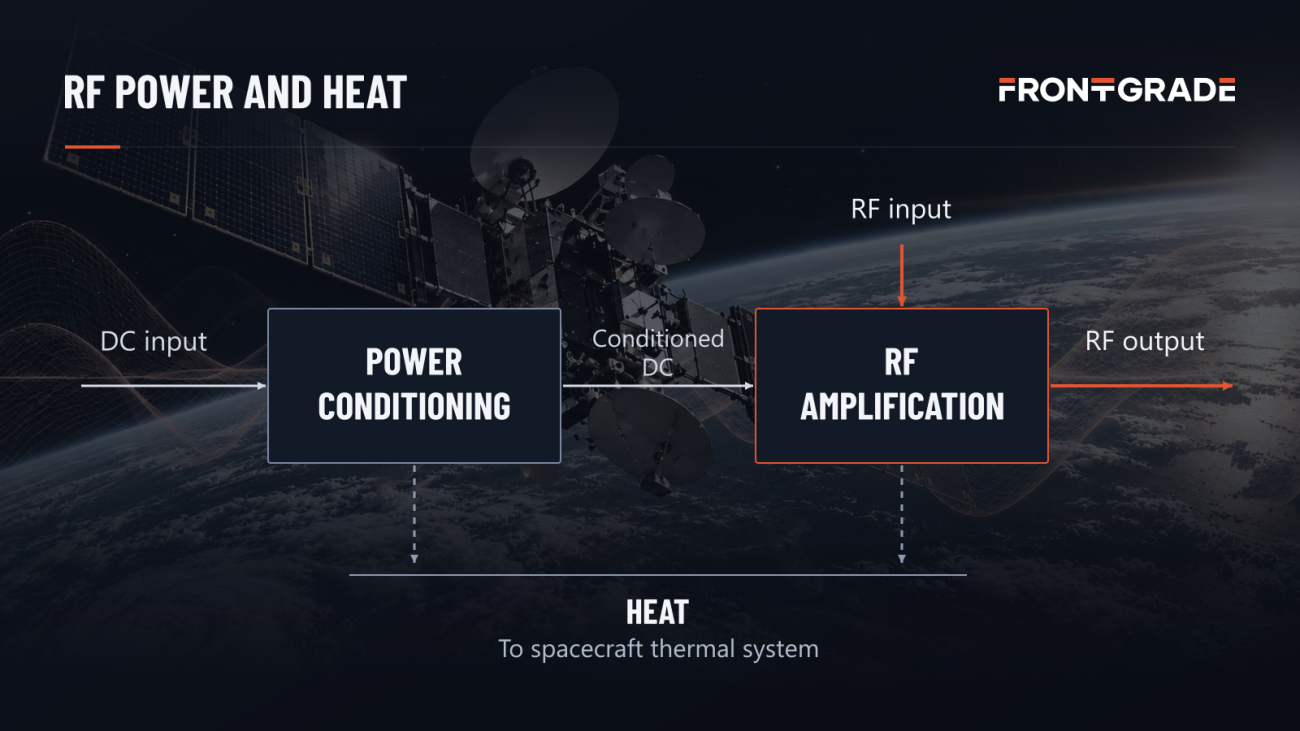
An RF amplifier can meet a spacecraft’s headline output-power requirement and still impose unnecessary electrical, thermal, and mass burdens. Simon Wood, Vice President of RF Systems at Frontgrade, explains why efficient selection starts with the frequency coverage, waveform, and operating conditions the mission actually needs.
Define power across the required frequencies
Does the mission require the same output across the full band? Must it transmit simultaneously across a wide bandwidth, or can operation be concentrated at specific frequencies?
A design targeted to narrower mission frequencies can offer efficiency advantages and potentially support a smaller, lighter solution. Where broad coverage is essential, its power and thermal demands must be accommodated.
A customer may also need higher output in one portion of a band and less in another. Reviewing that power profile may reveal an existing design that fits more closely than headline specifications suggest.
Evaluate efficiency at the required operating point
Communications waveforms may require an amplifier to operate below saturation to preserve signal quality. This output backoff can reduce efficiency, so saturated output power alone does not establish usable performance for the application.
For a payload supporting multiple operating modes, evaluate the output, linearity, and efficiency required in each mode. A waveform that permits operation closer to saturation may support a different amplifier choice.
Follow the thermal consequences into the spacecraft
Heat must be managed to keep the amplifier’s semiconductor devices within their operating limits. Wood notes that the required thermal hardware can contribute substantially to the amplifier assembly’s size and weight.
That burden extends beyond the RF subsystem. Additional mass can affect launch cost, while the space and resources allocated to RF hardware can limit what is available for other payload functions. Amplifier selection should account for those supporting thermal requirements.
Bring the system architecture into the discussion early
An architecture using several lower-power amplifiers presents different requirements from one built around a higher-power unit. Establish how the required power is divided and which frequencies, waveforms, and operating conditions apply to each amplifier.
Frontgrade’s discussions often begin with an existing product. Engineers can assess whether it meets the requirements or needs changes to its frequency coverage or power profile. Fit must be verified against the operating and environmental conditions; where the baseline cannot meet the mission, the remaining gap should be explicit.
Discuss your RF architecture
Bring your frequency coverage, output power, waveform, and platform constraints to Frontgrade’s RF team to evaluate the closest existing starting point and the changes your mission may require.
News & Insights
Ready to discuss your mission architecture?
Connect with engineers across RF, processing, microelectronics, and motion to evaluate the right architecture for your mission.