
Blog
Designing Counter UAS Systems for Continuous Change
RF agility, edge processing and modular interfaces determine how quickly counter-UAS programs can respond today and absorb new capability after fielding.
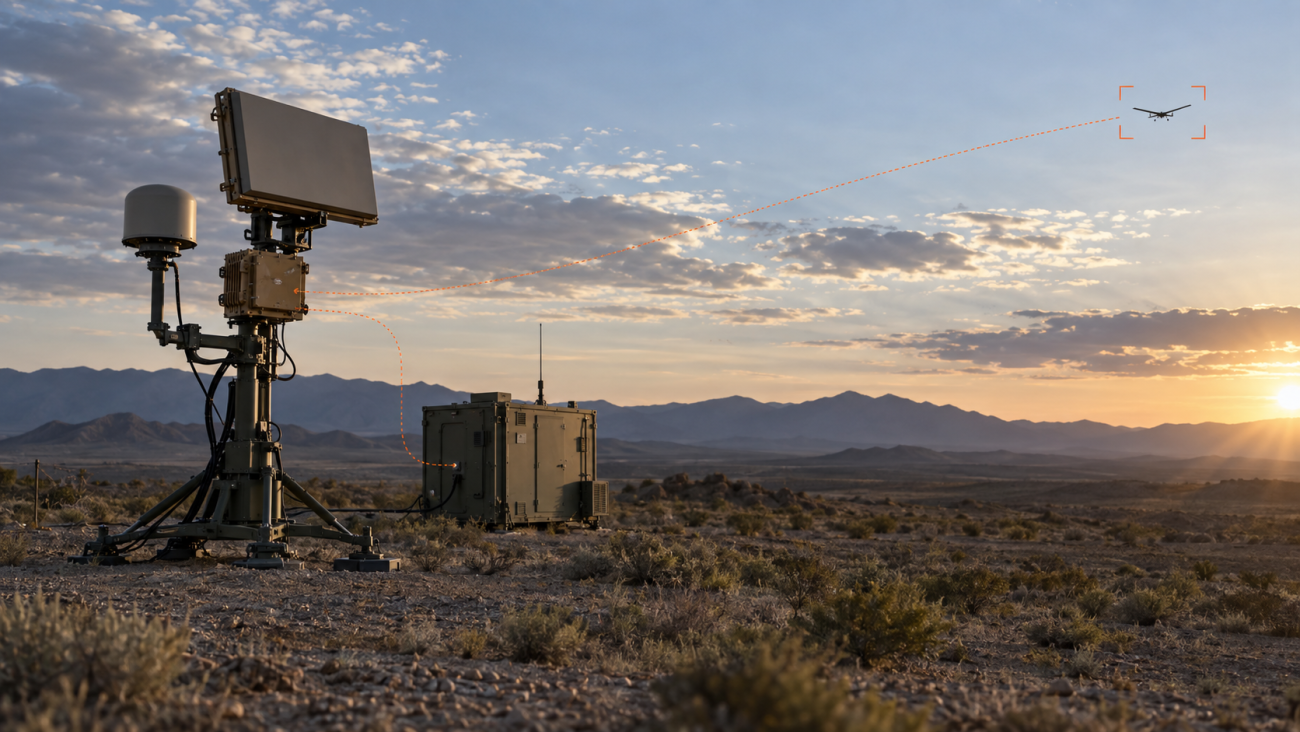
The counter-UAS mission is no longer defined by whether a sensor can detect a drone. System designers must detect, identify, track and respond to a widening range of threats within a compressed engagement window. They must also assume that frequencies, waveforms, behaviors and tactics will change after the system is fielded.
This puts the electronics architecture at the center of the mission. RF sensing, signal conditioning, data conversion, processing, networking and effects cannot be optimized in isolation. Their interfaces and timing determine how quickly a system can turn a detection into a coordinated response and how much of the architecture must change when a new capability is introduced.
I recently joined experts from Real-Time Innovations, Curtiss-Wright Defense Solutions and Epiq Solutions for a Military Embedded Systems roundtable on the technology and design choices shaping counter-UAS programs. The discussion focused on a practical question for program teams: how can an architecture keep pace when the threat changes faster than the platform?
Read the full Counter-UAS e-book from Military Embedded Systems
The Counter-UAS Mission Thread
| 01 Sense and receive RF coverage and signal fidelity | 02 Condition and convert Filtering, conversion and data movement | 03 Process and classify Edge compute and AI/ML | 04 Fuse and decide Shared tracks and command logic | 05 Respond and update Effects, assessment and capability refresh |
|---|---|---|---|---|
| Open interfaces | Deterministic timing | Power and thermal control | Cybersecurity | Mission assurance |
The Engagement Timeline Begins in the Signal Chain
Every stage consumes time and affects the information available to the next. The aperture and RF front end must capture relevant signals without losing fidelity. Filtering and conversion must preserve usable information across the required bandwidth. Processing must detect and classify activity quickly enough for command-and-control software and operators to act. Networking must move observations, tracks and decisions without introducing an uncontrolled delay.
An improvement at one stage cannot compensate for an unresolved bottleneck elsewhere. A faster processor cannot recover a signal lost at the front end. Wider-band sensing adds limited mission value if conversion, I/O, memory or networking cannot sustain the resulting data rate. Program teams need a latency and data budget that follows the complete path from sensing through assessment.
Customer requirements are therefore pushing wider-band and more agile RF sensing, greater signal-processing capability closer to the sensor, and software-defined RF that can adapt as waveforms change. AI and machine learning can help distinguish threats from a complex background and reduce the amount of information presented to an operator, but those algorithms still depend on signal fidelity, predictable data movement and sufficient compute at the point of need.
Threat economics add another constraint. Programs cannot assume that an expensive response is appropriate for every low-cost target. The architecture must support more simultaneous targets, more frequencies and new behaviors without requiring a complete redesign each time. That shifts attention from the peak specification of one component to the sustained performance of the electronics backbone.
Open Architectures Must Contain the Cost of Change
A modular open systems approach is valuable in counter-UAS because the threat is likely to evolve faster than the host platform. Well-defined boundaries between sensing, RF, processing, networking and effects give program teams a better chance to upgrade one element without reopening the entire design.
SOSA-aligned OpenVPX architectures can establish common physical and functional profiles for rugged processing where those standards fit the mission. The same discipline should extend to data formats, timing, software interfaces and network behavior. An interface is useful only when both sides agree on what data moves across it, when it must arrive and what happens when a node or link degrades.
Standards do not remove systems engineering. Integration, power, thermal management, cybersecurity, qualification and mission assurance remain program-level responsibilities. The practical goal is to reduce the scope and risk of change. If a processor refresh forces a redesign of the RF chain, or an algorithm update triggers requalification across every subsystem, the architecture is not providing the intended modularity.
“Open standards aren’t a substitute for good systems engineering.”
Simon Wood
Distributed Sensing Changes the System Boundary
The next architectural shift is from platform-centric counter-UAS systems toward distributed, software-defined sensing and effects. In that model, sensors share observations across a network, processing occurs closer to where data is collected, and software helps determine which sensor or effect is best positioned to respond.
Distribution can improve coverage and give the system more options, but it introduces requirements that are easy to underestimate. Nodes need coherent data models and precise time references. Networks need sufficient capacity and bounded latency. The architecture must define degraded-mode behavior when a link is denied, a sensor drops out or the number of targets exceeds the nominal load.
AI is one element of this architecture, not a substitute for it. Its value comes from combining distributed observations with edge processing, software-defined RF and an upgrade path for validated algorithms and waveforms. Continuous adaptation should mean that approved capability can be integrated, qualified and deployed without destabilizing the rest of the system. It should not mean uncontrolled change in a mission-critical environment.
Questions for Early Architecture Reviews
Chief engineers and program teams can expose integration risk early by answering five questions before component selection is locked:
- What is the end-to-end latency budget from RF detection through classification, decision, response and assessment?
- What spectrum coverage, dynamic range, conversion rate, processing throughput and network capacity must the system sustain under peak load?
- Which electrical, mechanical, data, timing and software interfaces must remain stable across upgrades?
- Which elements can be replaced and qualified independently, and which changes force system-level requalification?
- How will the system behave when sensors, links or compute nodes are degraded, denied or saturated?
These questions create a common technical frame for the prime, subsystem suppliers, software teams and government customer. They also identify where margin is required. Bandwidth, compute, power, cooling and qualification capacity are not reserves to add after the design is complete; they determine whether the program can absorb the next threat-driven update.
Build Adaptability Into the Electronics Backbone
No counter-UAS program can predict every waveform, behavior or tactic it will encounter. It can design an electronics backbone that protects signal fidelity, places processing where it shortens the mission timeline, and preserves a controlled path for technology insertion. That requires RF, compute, interfaces, timing, power, thermal management and mission assurance to be evaluated as one architecture.
The relevant measure is not a single component specification. It is how quickly a program can integrate and qualify a new sensor, processing capability, algorithm, waveform or countermeasure while preserving known system behavior. That is how architecture helps counter-UAS teams operate inside the adversary’s innovation cycle.
Frontgrade brings RF systems, mission processing, microelectronics and motion control into architecture discussions so program teams can address cross-domain tradeoffs before interfaces and qualification plans are fixed.
News & Insights
Ready to discuss your mission architecture?
Connect with engineers across RF, processing, microelectronics, and motion to evaluate the right architecture for your mission.